
Anyone who writes about waste incineration tends to look at the bunker, the furnace and the flue gas cleaning. Bottom ash is considered the dull part: a grey residue that comes out at the end and has to be landfilled somewhere.
In September I stood in a hall in Hinwil, in the Zurich Oberland, among red steel girders, yellow screens and blue extraction pipes, holding a handful of that residue. Except it was no longer grey: copper wires, brass-coloured pieces, silvery lumps, a screw. And even a little gold. All of it from bottom ash.
What’s in the bottom ash
ZAV Recycling AG processes the dry-discharged bottom ash of several Swiss waste-to-energy plants in Hinwil, together around a quarter of all bottom ash in Switzerland. From it, the Swiss recover iron and steel, aluminium, silver and gold, among other things.
Getting at the precious metal takes precision work. There is not much gold in residual waste, not even in Switzerland. The fire concentrates the metal first, then magnets, screens, eddy current separators and separation tables take over. How that works in detail, and why there is deliberately no shredder in the hall, is what I tell in the cover story.
The trick happens at the furnace
What stayed with me most after the visit: the plant’s success is not decided in the processing hall but at the furnace outlet. The vast majority of incineration plants worldwide drop their bottom ash into a water bath. In Hinwil it comes out dry. Why that makes the difference, and what it costs, is in the magazine.
What doesn’t glitter
From a circular economy point of view, it is still not a pure success story. With the mineral fraction, most of the bottom ash still goes to landfill, and landfill costs rise every year. Then there are lithium batteries in household waste, cat litter in the bottom ash and the open question of whether the route through the furnace recovers more metal from electronics than shredding does. We talked about that in Hinwil, too.
What else is in the issue
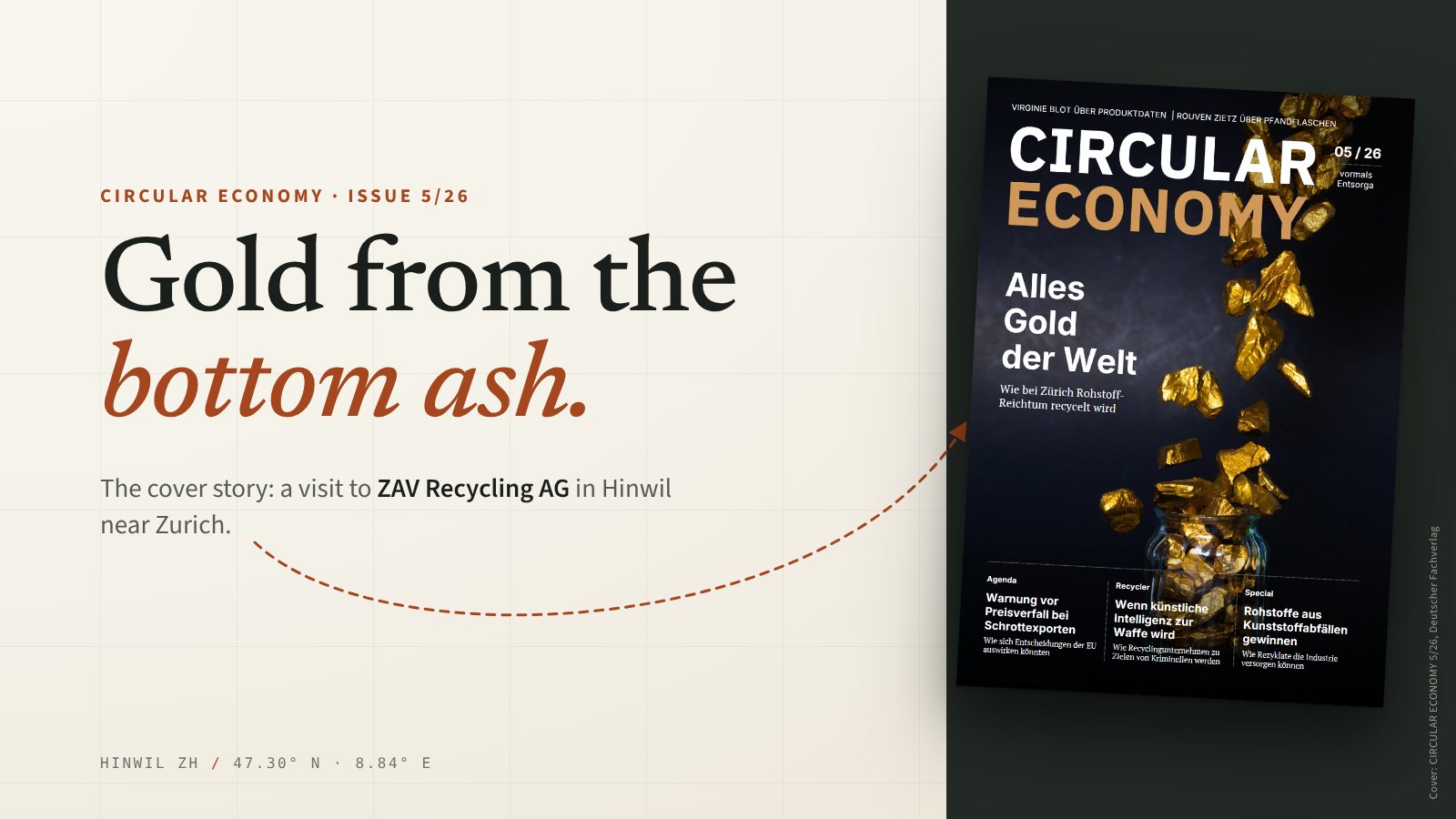
The cover story is not the only topic of issue 5/26. Also in the magazine:
- Agenda: a warning of falling prices for scrap exports and how EU decisions could play out.
- Recyclers: when artificial intelligence becomes a weapon, and how recycling companies become targets for criminals.
- Special: raw materials from plastic waste and how recyclates can supply industry.
Where to get it
CIRCULAR ECONOMY is published in German.
- Issue 5/26 is available as an e-paper on umweltwirtschaft.com,
- subscriptions are in the Deutscher Fachverlag shop.
- Current circular economy news is published continuously on umweltwirtschaft.com.
By the way, I didn’t see a single gold bar in Hinwil. The precious metal leaves the plant hidden in around 600 tonnes of metal concentrate and only becomes pure gold at the smelter.