
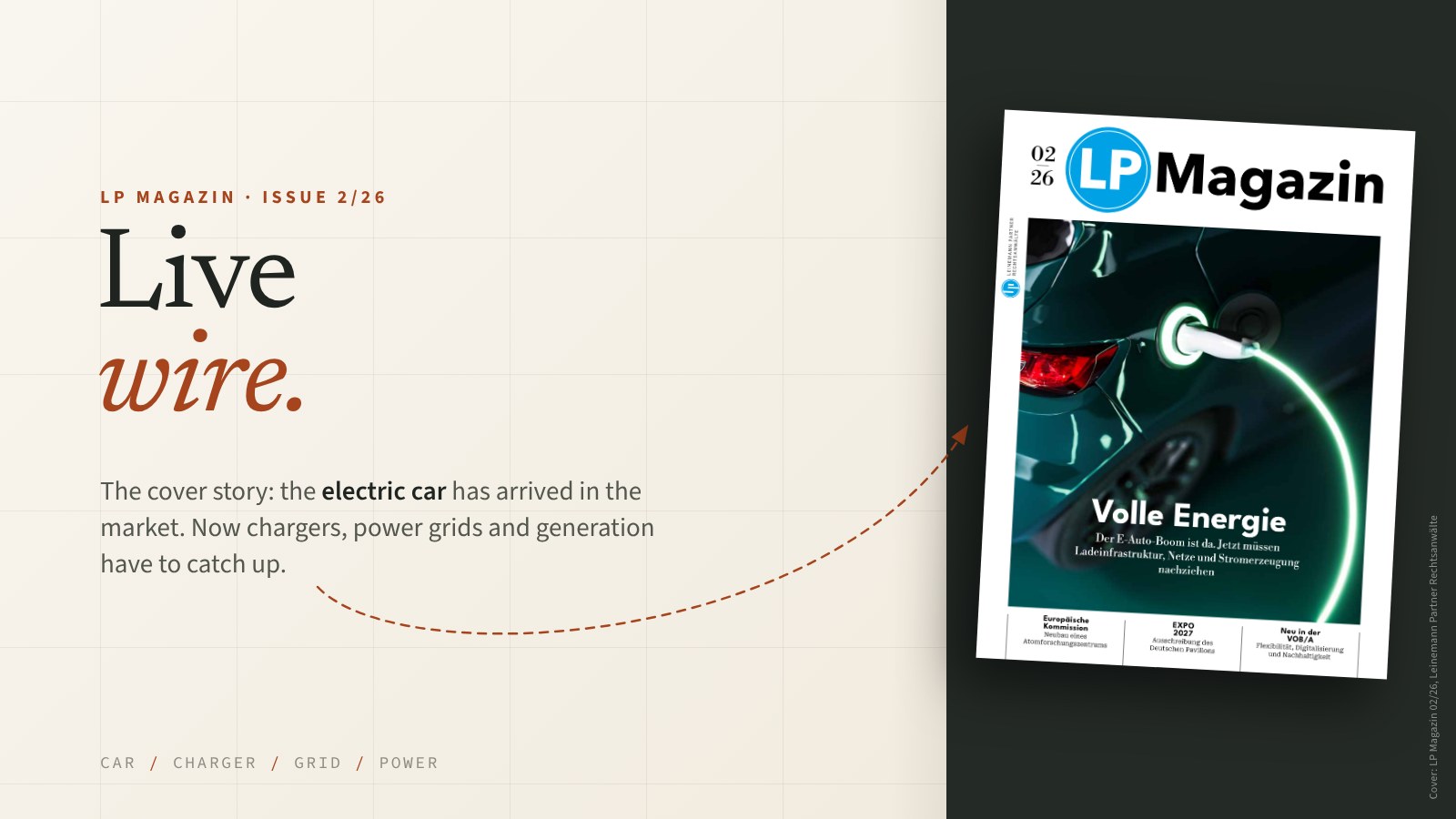
In Germany, the argument about electric mobility is usually an argument about the car: range, price, purchase incentives. In the summer of 2026 the market settled a good part of that argument. In June, the battery-electric car was ahead of every other single drive type in new registrations for the first time, and in August almost one in three new cars was fully electric.
So for the cover story in the new LP Magazin, I was less interested in the car than in everything attached to it. The piece is called “Unter Strom” – roughly, “Live wire” – and it follows the electricity backwards: from the charging port through the charger and the distribution grid to generation.
A chain with four links
The vehicle is only the most visible link in a long chain. Behind it come the charging infrastructure, the power grids and electricity generation, and each of these links has to grow along with it if the shift to electric driving is to hold. So I put the same question to each of them: is what’s there enough?
The answers differ widely. Take the charging network: public charging points in Germany are occupied only twelve per cent of the time on average. That is good news for everyone who drives electric and expensive news for the operators. How the business can still add up is what Elke Temme of Stadtwerke Bochum, the city’s municipal utility, explained to me.
The bottleneck is underground
The weakest link is neither the car nor the charger. It is the distribution grids that carry the power to the wallbox. And the problem even has a time of day: early evening, when everyone in residential areas comes home and wants to charge. How far municipal grid operators plan to expand their networks as a result, what that costs and why they are annoyed about the new grid regulation right now is in the magazine.
So is the good news: the electric car does not have to overload the grid if charging is managed intelligently. And the industry has put forward a proposal that sounds unspectacular and could still change a lot. It concerns a piece of equipment everybody walks past every day without noticing it.
The biggest battery is in the garage
That leaves the question of whether there is enough electricity at all. The experts are remarkably relaxed about it: the issue is not how much, but when and where the power is needed. What is needed, then, is storage, and the biggest storage unit may already be parked in the garage. Technically, electric cars have long been able to feed their power back into the grid. What has stopped this in practice so far, and what Volkswagen and its charging subsidiary Elli are planning for the end of the year, is what I tell in the last part of the story.
Where to get it
LP Magazin is published in German and is free of charge. Issue 02/26 is available as a PDF in the magazine archive of Leinemann Partner; the cover story starts on page 6.
By the way, the cover shows a charging cable glowing in rich green. The real bottleneck of electric mobility is less photogenic: it sits in the grey boxes at the roadside where electricity is stepped down to the 400 volts for wallbox and socket.